
Summary: Bengal Cats are categorized into generations F1 through F2, and there are personality, care, and ownership differences between generations. For those considering buying a Bengal, it is important that they have an understanding of these bloodlines, to ensure that they acquire one that best fits their lifestyle and from a reputable Bengal cattery.
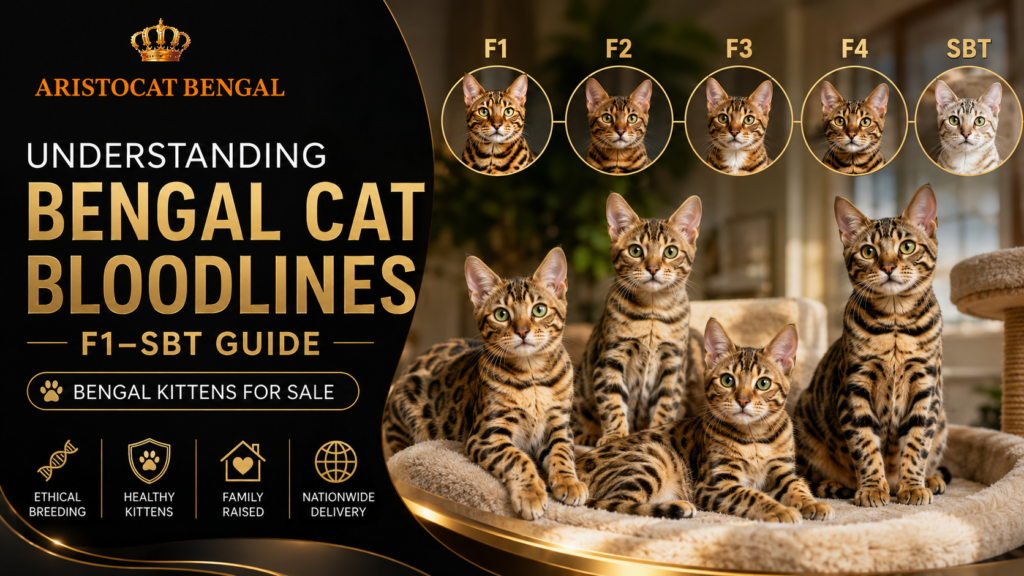
Choosing a Bengal cat involves much more than admiring its distinctive spotted coat. One of the most important factors to understand is its bloodline, as each generation, from F1 to SBT, shapes the cat’s personality, activity level, and care needs. If you’re exploring Bengal kittens for sale, knowing how these generations differ will help you select a companion that fits your lifestyle and expectations.
What are the Generations of Bengal Cats?
The Bengal cat is a mix of the leopard cat of Asia and the domestic cat. The “F” denotes “filial generation”-how many generations a cat is removed from its wild ancestor.
Generally, as each successive generation strives to be further removed from the family of Asian leopard cats, Bengals grow more predictable and family-friendly.
The main generations are:
- F1
- F2
- F3
- F4
- F5 and beyond (usually SBT)
Once an owner understands these categories, he or she can be more prepared to have realistic expectations when it comes time to adopt a Bengal.
F1 Bengals: Closest to Their Wild Heritage
F1 Bengals are the crossbreeding of one Asian leopard cat and one domestic cat. They tend to have a great many traits from the wild relatives they come from.
These cats are:
- Highly intelligent
- Extremely active
- Likely to be suspicious of or wary of strangers
- Increased levels of environmental stimuli
Experienced owners with an understanding of how to train their cats with advanced training are often required to handle F1 Bengals. They require plenty of room, lots of stimulation and regular routines to keep them happy and healthy.
The F1 Bengals are especially a breed for experienced Bengal owners as they have specific requirements.
F2 and F3 Bengals: A Balanced Transition
Bengals start to exhibit more domestic traits with athletic personalities as breeding goes along from F2 and F3.
Owners can expect:
- Strong curiosity
- High energy
- Interactive personalities
- Excellent climbing abilities
Few relationships in the home are cohesive. There are not strong relationships with family members.
Mere daily enrichment, puzzle toys, climbing structures and frequent play time still are needed for these generations. They tend to be easier to manage than F1 Bengals, though, in general, they are as smart as the rest of the breed.
F4 and Later Generations
Bengals are much more domesticated when it comes to temperament and care by the F4 generation.
The majority of F4 Bengals are:
- Social
- Confident
- Family-oriented
- Easier to train
- Easier on the house’s hustle-bustle
These generations are of interest to many reputable breeders since it allows them to have a beautiful Bengal animal within a family environment.
What Does SBT Mean?
SBT is an acronym for “Stud Book Tradition.” This designation can only be applied to Bengals bred from Bengal-to-Bengal pairings for several generations.
SBT Bengals are the benchmark of many breeding schemes due to having:
- Predictable personalities
- Stable temperaments
- Consistent breed characteristics
- More adaptations in environmental conditions as companions to others
One of the reasons why many buyers buy Bengal kittens for sale is because of their straight forward and reliable temperament. But when looking around the world for Bengal kittens for sale, many interested shoppers are specifically searching for SBT kittens to help them appreciate that their cat is a descendant of a reliable, known lineage.
How Bloodlines Affect Personality?
Bloodline can directly affect a Bengal’s lifelong attitude.
Inability to stick to tasks and activities, and failure to follow instructions:
- Greater independence
- Increased territorial instincts
- Higher prey drive
- More cautious behavior
Subsequent generations tend to exhibit:
- Greater sociability
- Strong family attachment
- Better adaptability
While every cat has its own personality, understanding bloodlines helps owners anticipate common behavioral tendencies.
How You Take Care of Them vs. How You Care for Them?
Carers of a Bengal are more specialized the closer that Bengal is to his wild relatives.
Most of the previous generations need:
- Larger living spaces.
- Extensive climbing opportunities.
- Advanced enrichment.
- Frequent interactive play.
- Experienced handling.
Subsequent generations require a degree of activity; but cope well with the more familiar indoor settings.
No matter how many generations they’ve gone through, whether a single generation or multiple, Bengals get the best results from:
- High-quality nutrition
- Daily exercise
- Interactive toys
- Vertical climbing spaces
- Regular veterinary care
Addressing these needs can aid with physical and emotional needs.
Conclusion
If you take the time to learn about the Bengal bloodlines, you’ll be able to gain valuable insight of what it will truly be like to have a Bengal. Nobody would prefer to own a wild animal that is prone to quarrelling and fights with other cats or becomes overly aggressive and aggressive, and yet someone will insist on buying such a cat for companionship. If you want to enjoy your cat’s company, you shouldn’t buy a fighting and temperamental kitten or one that is too aggressive and aggressive, the way people call it. These differences will be explained to you by a trusted breeder, and they’ll help you find the perfect furry roommate for you.
Explore healthy, well-socialized Bengal Kittens for Sale from the trusted breeders at Aristocat Bengal and find the perfect feline companion for your family.
FAQs
1. What is the difference between F1 cat and SBT Bengal cat?
A first generation cat is one that comes from an Asian peasant cat as its parent, and the second generation of cats is several generations of removal that have been bred only with Bengal parents and are better suited as domestic pets.
2. What’s the best generation of Bengal?
F4, F5 and the Bengal Tiger that is an SBT will be better suited for the first-time Bengal owner as these are more predictable and have better genes to adapt to family environment.
3. Does a Bengal’s generation affect its personality?
Yes. Older generations tend to have more wild instincts, younger generations are more social, and more flexible/family oriented.
4. Why should I choose to purchase from a Trustworthy Bengal Cattery?
A trusted Bengal Cattery will be keen to test for reproductive health and ensure good socialization, along with ethical breeding and clear pedigree information to ensure you’re assured you’re looking at a healthy, well-bred cat.
5. Are later-generation Bengal cats less active?
No, even SBT Bengals are energetic, they are intelligent and they are playful as well. They are just more predictable and easier to manage than previous generations and still need daily enrichment and exercise.